What OSHA Requires When Your Plumbing Crew Digs a Trench
Sewer and water service work means excavation, and the federal OSHA trenching rules apply to a two-man plumbing crew the same as a highway contractor. Here's what the standard actually says.
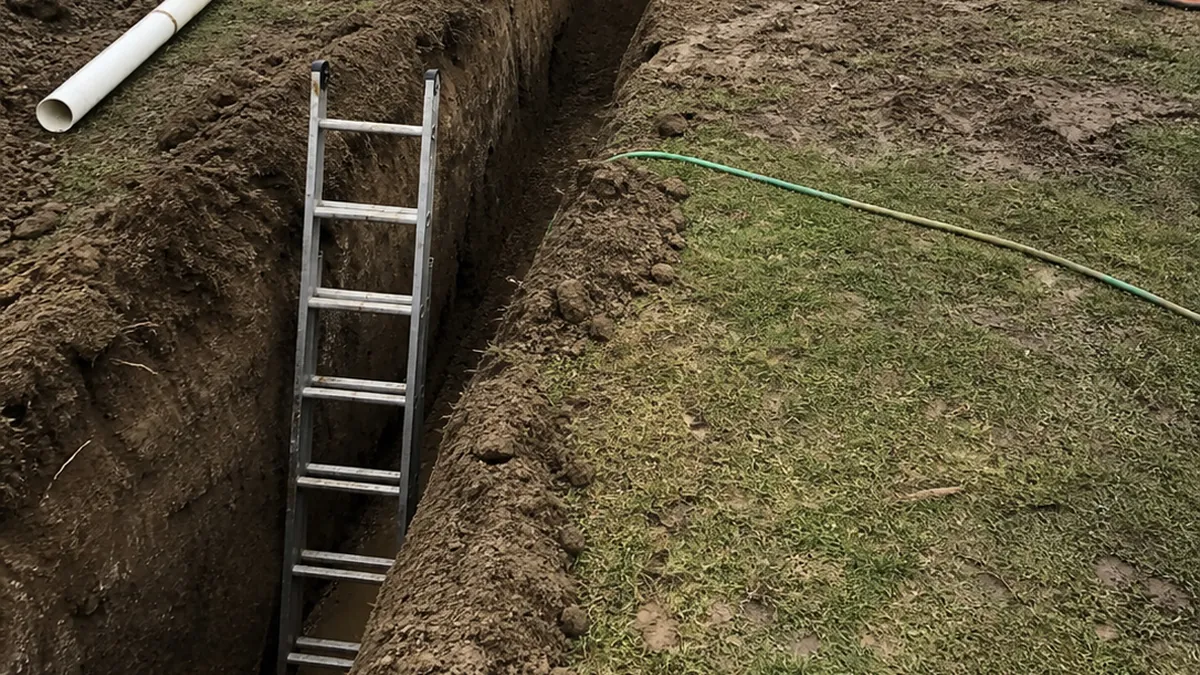
Under the federal OSHA excavation standard, employees in an excavation need a protective system, meaning sloping, benching, shoring, or a trench shield. There are two exceptions: excavations made entirely in stable rock, and excavations less than 5 feet deep where a competent person has examined the ground and found no indication of a potential cave-in. Separately, any trench 4 feet or deeper needs a ladder, ramp, or other safe exit within 25 feet of lateral travel, and a competent person has to inspect the excavation before work starts each day.
That’s the short version. The part that catches plumbing shops out is that none of this is scaled down for a small job.
Why this lands on plumbing shops
A shop replacing a sewer lateral or a water service line is doing excavation work, and OSHA’s excavation standard, 29 CFR 1926 Subpart P, doesn’t have a small-job exemption. The requirements that apply to a utility contractor with a full crew apply to two plumbers and a mini excavator in someone’s front yard, as long as those plumbers are employees. There’s no two-person-crew exception. (A genuinely self-employed person with no employees generally falls outside OSHA’s coverage, which is a different situation from a small shop with a payroll.)
This matters more as shops take on more underground work. If you’re weighing lead service line replacement contracts or already running service line replacements, you’re in this standard’s scope on every dig, and utility and municipal contracts tend to check.
Two notes on scope before the details. First, everything below is the federal baseline. OSHA-approved state plans can set requirements that differ from it or go beyond it, so check your own state. If you work in California, for example, Cal/OSHA generally requires a permit to construct a trench or excavation 5 feet or deeper that a person will enter, subject to specified exceptions. Second, this covers the requirements crews run into most, not the whole of Subpart P.
What the standard actually says
Protective systems, and the “5 foot rule” misunderstanding
The rule at 1926.652(a)(1) is that “each employee in an excavation shall be protected from cave-ins by an adequate protective system.” The shallow-trench exception is narrower than most people repeat it. The standard exempts excavations “less than 5 feet in depth” only where “examination of the ground by a competent person provides no indication of a potential cave-in.”
So “it’s only four feet, we’re fine” isn’t what the rule says. The exception depends on a competent person actually examining the ground and concluding there’s no cave-in potential. If the soil is previously disturbed, wet, or next to a road or another trench, that conclusion may not be available to you, and the protective system is required regardless of the four-foot depth. At exactly 5 feet, the shallow-excavation exception is gone entirely.
A way out, at 4 feet
Under 1926.651(c)(2), trenches 4 feet or more deep need “a stairway, ladder, ramp or other safe means of egress” positioned so no worker has more than 25 feet of lateral travel to reach it. Note this kicks in a foot shallower than the protective-system threshold, which is easy to get backwards.
Keep the spoil pile back
Excavated soil and equipment have to be kept “at least 2 feet from the edge of excavations,” or restrained so they can’t roll in (1926.651(j)(2)). The spoil pile is part of the load on the trench wall, which is why the setback exists rather than being a tidiness rule.
Water in the trench
This one is squarely aimed at the work plumbers do. Under 1926.651(h)(1), employees “shall not work in excavations in which there is accumulated water” unless adequate precautions have been taken against the hazards it creates. Water undercuts the trench wall and changes the soil you assessed when you opened the hole, so yesterday’s judgment doesn’t carry over.
If you’re pumping to keep the hole dry, 1926.651(h)(2) requires that “the water removal equipment and operations shall be monitored by a competent person to ensure proper operation.” Running a pump isn’t a substitute for the assessment, it’s an operation that itself has to be watched.
Hazardous atmospheres
This won’t apply to every dig, and it doesn’t mean a routine 4-foot trench needs air testing. But where oxygen deficiency or another hazardous atmosphere “exists or could reasonably be expected to exist,” 1926.651(g)(1)(i) requires the atmosphere to be tested “before employees enter excavations greater than 4 feet in depth.”
For sewer work, that condition comes up more than shops expect: near existing sewer lines and manholes, around landfills or contaminated ground, and anywhere sewer gas could migrate. If there’s a reason to expect it, testing comes before entry, not after someone feels lightheaded.
Daily inspections by a competent person
Under 1926.651(k)(1), a competent person must inspect the excavation, the adjacent areas, and the protective systems “prior to the start of work and as needed throughout the shift,” looking for cave-in indications, protective system failures, hazardous atmospheres, and other hazards.
The same paragraph adds a trigger that’s easy to forget on a multi-day residential job: “inspections shall also be made after every rainstorm or other hazard increasing occurrence.” A trench you left open Friday in dry soil is not the same trench Monday morning after it rained.
The “competent person” is the part shops get wrong
This is a defined role, not a compliment about your most experienced plumber. A competent person has to be capable of identifying hazards in the excavation and have the authority to take prompt corrective action, which includes pulling people out of the trench. Two practical consequences for a small shop:
- Someone has to actually hold that role on every dig. If your crew is two people and neither has the knowledge or the authority, you don’t have a competent person on site.
- They need real authority to stop work. A designated person who can’t halt a job without calling the owner first doesn’t satisfy the intent of the rule.
Worth being clear on what this does and doesn’t require. OSHA doesn’t mandate a particular certification or course here. The employer assigns the role based on the person’s actual capability, knowledge, and authority to correct hazards. In practice that knowledge covers soil analysis, protective systems, and the requirements of the standard. Training is a sensible way to build it, but finishing a course by itself doesn’t make someone a competent person, and no credential substitutes for the authority half of the definition.
Building that capability in someone already on your payroll is usually the practical path, and it’s the same calculation as any other skills decision: the trade’s hiring market is tight enough that developing someone you already employ tends to beat trying to hire it in.
Before your next dig
Worth confirming your shop has each of these in place:
- A competent person on site for every excavation, with the knowledge and the authority the role requires
- A protective system available, and the judgment to use it below 5 feet when conditions warrant
- Ladders or ramps staged for any trench 4 feet or deeper, within 25 feet of lateral travel
- A habit of setting spoil at least 2 feet back from the edge
- A plan for water, including who is monitoring the pump
- Pre-work inspections that actually happen, plus another one after rain
- Utility locations determined before excavation wherever underground utilities may be encountered, with the utility companies or owners contacted to establish them
One more angle worth weighing: some of this work doesn’t require an open trench at all. Where the job allows it, trenchless methods reduce both the exposure and the restoration cost, which is part of why customers often prefer them.
Frequently asked questions
Do I need a trench box for a 5 foot trench? Not necessarily a trench box specifically. At 5 feet or deeper you need a protective system of some kind, sloping, benching, shoring, or a shield, unless the excavation is made entirely in stable rock. Which one is appropriate depends on soil conditions and the design options in the standard.
Does OSHA apply to a small plumbing shop? The excavation standard doesn’t exempt jobs based on size or crew count, so if you have employees, assume Subpart P applies on a dig. Note that state plans may impose additional requirements beyond the federal standard.
Who can be a competent person on a trench job? Someone capable of identifying excavation hazards and authorized to take prompt corrective action, including stopping work. It’s about demonstrated knowledge and real authority, not seniority, and not a specific certificate.
How deep can you dig without shoring? Less than 5 feet, and only when a competent person examines the ground and finds no indication of a potential cave-in. Depth alone doesn’t settle it.
How far from the trench should the dirt pile be? At least 2 feet from the edge, or restrained so it can’t fall or roll in.
Do you have to test the air in a trench? Not routinely. Testing is required before employees enter excavations greater than 4 feet deep where oxygen deficiency or another hazardous atmosphere exists or could reasonably be expected, which is a real consideration around existing sewer lines.
The takeaway
Trench work is the highest-consequence thing most plumbing shops do, and the core requirements are specific enough to check yourself against in an afternoon. Two that are easy to miss on small jobs: egress becomes mandatory at 4 feet, a foot shallower than the protective-system threshold, and the competent person role has to be genuinely filled rather than assumed.
One practical note: a crew that’s in a trench, or running an excavator, isn’t answering the phone. That’s the same reason you can’t take a call with your hands in a drain. Bella picks up while the crew stays focused on the dig, and texts you what came in. See a 10-minute demo.