Running Late? Make the Call Before the Customer Does
Running behind on a plumbing job? Contact the next customer before the window closes, give a padded time you can keep, and offer to reschedule.
TL;DR: Call or text the customer as soon as you know you will miss the arrival window, before the window closes. Give a new time you can keep, and offer another day if waiting no longer works for them.
The silence makes a late arrival worse
The late arrival itself rarely loses the customer. The silence does.
The customer may have taken time off work or rearranged the day to be home for your arrival window. When that window passes with no word, they assume they have been forgotten. Then they start calling other shops.
A short heads-up before the window closes keeps most of them waiting for you.
We see this in call summaries from shops. A very common call is, “Is anyone still coming?” It comes from a customer who took the morning off work and lands shortly after the arrival window closes. Often, it is the second call from the same number within a short stretch. Customers who already got a heads-up text before the window closed rarely make that call at all.
Call when you know, not when you are already late
Call or text as soon as you know you will miss the window.
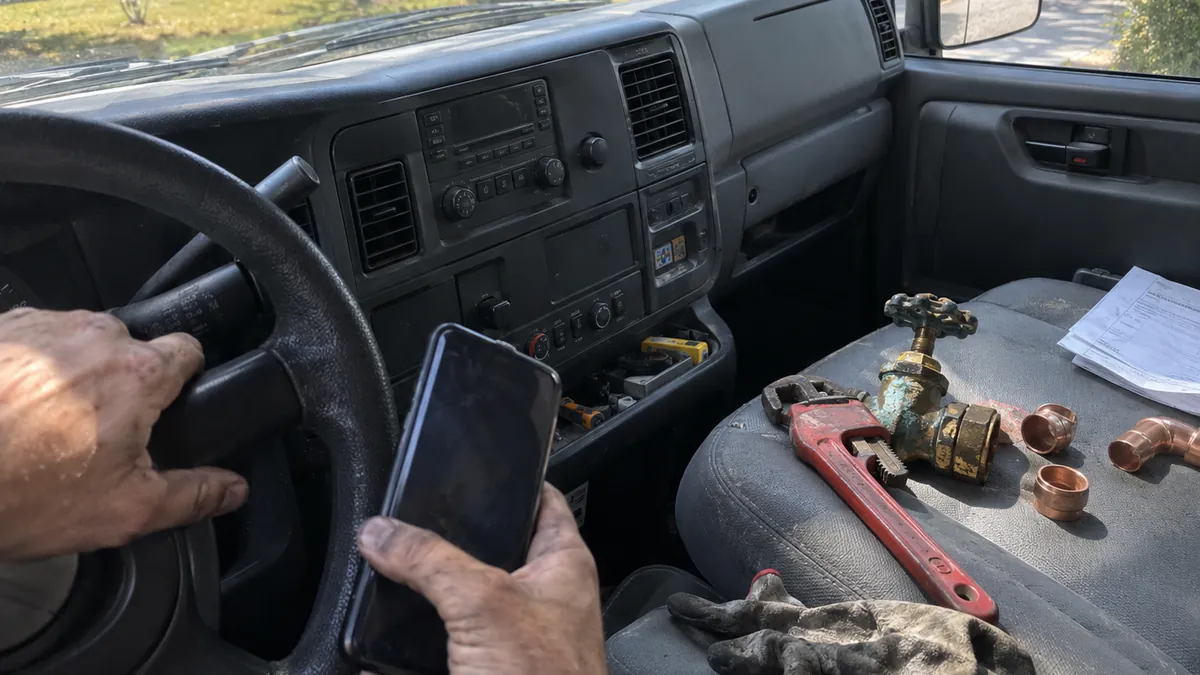
If the job you are on will clearly run past the time you needed to leave, contact the next customer right then, from the truck, before you crawl back under the sink. Do not wait to “see how it goes.” A seized valve, a slab leak, a rotted shutoff, or traffic can turn a quick job into a long one. Once you know the schedule has changed, the customer should know too.
The timing matters. A message sent before the arrival window closes gives the customer a choice. A message sent after the window closes sounds like an excuse for leaving them there.
Keep the message short and give one reason
The customer does not need the whole story from the previous job. They need to know who is calling, what changed, and when you can arrive.
Use this structure:
- Your name and shop.
- A plain statement that you are running behind.
- One short reason.
- A new arrival time.
- A choice between waiting and rescheduling.
For example:
This is [name] with [shop]. The job before you ran long. I can be there by 2:30 instead of 1:00. Does that still work, or would you rather pick another day?
Do not blame the previous customer. The customer is deciding whether the new time still works.
A text is fine for a short delay and lets the customer reply when convenient. A call is better for a long delay or a reschedule. Either way, include the new time.
The second time has to be real
Give a new time you can actually keep. Pad it.
Arriving early on a revised time repairs trust. Missing the second promised time does real damage.
This also applies when the next available appointment is not today. Booked Solid: What to Tell the Next Caller deals with giving a customer a date you can keep instead of making a promise your schedule cannot support.
Let the customer choose between waiting and moving
Some customers would rather wait. Others would rather move the appointment to tomorrow morning and get on with the day.
That respects the time they set aside. It also gives you a chance to keep the job. If they choose another day, book a firm slot on the spot. Do not leave the reschedule as a vague promise to call later. A customer who is still waiting for a time may start shopping again.
Reminders help with the other side of the schedule, too. No-Shows Are Eating Your Schedule covers reminders and wasted slots.
Active water and gas smells need a different response
An urgent customer cannot wait an open-ended amount of time.
If water is actively running, sewage is backing up, or the customer has no water, tell them how to shut off the main water valve while they wait. If you truly cannot get there in a reasonable time, say so. Give them a referral to another shop you trust.
A gas smell is different. The caller should leave the house and call the gas utility or 911 first. Do not treat that call as an ordinary late-arrival conversation.
The office needs the changed schedule
While you are under a sink, the phone keeps ringing. The waiting customer calls to ask, “Is anyone still coming?”
Whoever answers needs to know the schedule changed. The customer should get a real answer, not, “I’m not sure. I’ll have him call you.”
Bella, Plumber Secretary’s phone assistant, answers every call 24/7, including the “where is the plumber?” call while your hands are under a sink. She takes the details, flags emergencies to you right away with an instant alert, books jobs into open slots on your calendar through calendar sync, and sends you a call summary by text or email. You know who called and what they need before you call back.
On the Growth plan, which costs $295 per month, Bella also sends appointment reminders and handles two-way texting. Starter is $95 per month. Pro is $495 per month. You can reach Plumber Secretary at (707) 620-5284. To hear Bella answer, call the demo line at (669) 284-5564.
You Can’t Answer the Phone With Your Hands in a Drain explains why that office coverage matters when the work cannot wait.
A quick acknowledgment is enough when you arrive
When you get there, say, “Thanks for waiting.” Then do the job well.
Do not turn one late day into a pattern. If you are late most days, the problem is how you are booking windows. The windows may be too tight, or you may be booking too many jobs in one day.
For the next late job, do one thing differently: contact the next customer as soon as you know you will miss the window, give a padded time you can keep, and ask whether they want to wait or reschedule.