New Construction or Service Work? What Each One Does to Your Phone
Builder work brings steady hours and bigger jobs but pays on the builder's schedule. Service work pays sooner but lives and dies on the phone. Here is how to weigh the two for a small plumbing shop.
TL;DR: Builder work gives you planned hours and larger jobs, but payment waits on the builder’s schedule. Service work generally pays sooner and at a better margin per hour, but a missed call often means a lost job.
New construction can quietly take service work away from your shop. The reason is not only money or scheduling. It is the phone.
Builder work puts fewer customers on your books
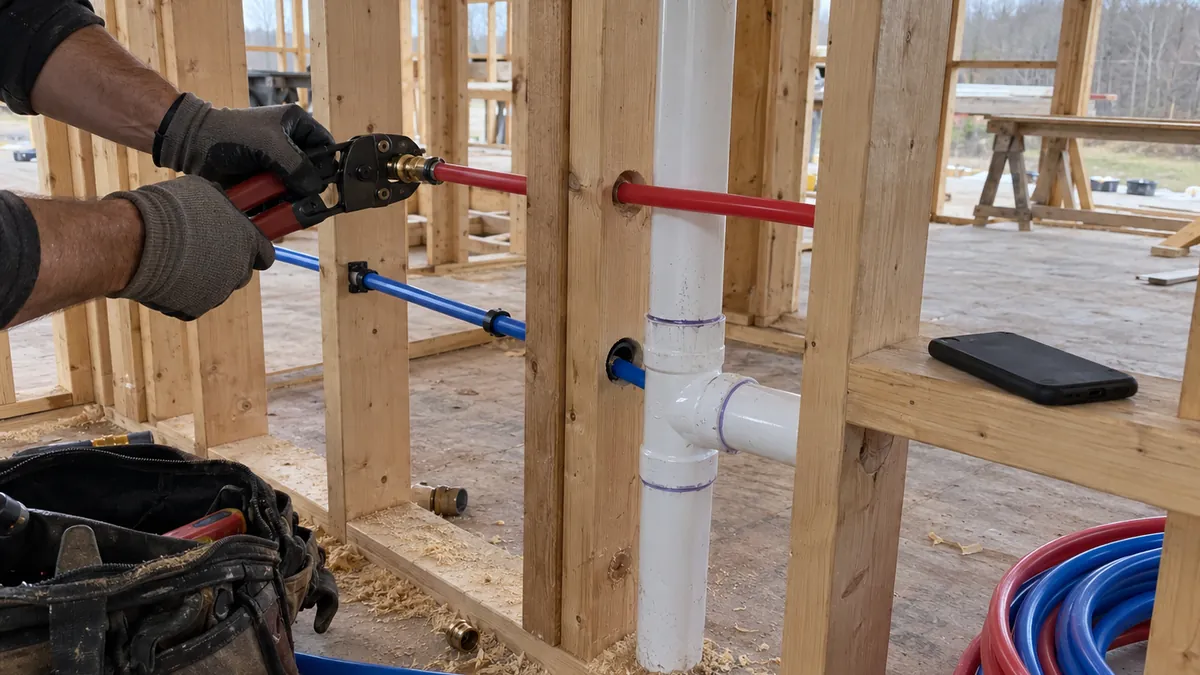
New construction usually comes from a small number of builders or general contractors. Each customer may send you larger jobs, such as rough-ins and trim-outs for new homes or remodels.
The work follows the build. You rough-in before the walls close. You come back for trim and finish work later. If another trade falls behind or an inspection slips, the site super calls to move your date. That call often comes with short notice.
You are usually bidding per house or per fixture. You are competing against other plumbers, so margins tend to be thin. The work can still fit a small shop well. Your crew gets predictable hours. Materials can be planned. There is less driving from one address to the next. A newer helper may learn faster in a steady build routine.
The payment schedule is different from service work. You may finish your part and still wait for the builder’s draw or pay app. Construction contracts often hold back part of each payment, called retention or retainage, until the whole job is finished. That waiting is a real cash-flow cost. Review your payment terms before you accept the work, as discussed in Getting Paid: Deposits, Terms, and Late Invoices.
There is also concentration risk. If one builder slows down or sends the work elsewhere, a large share of your schedule can disappear with that relationship.
Service work pays sooner but demands the phone
Service work comes from many customers. Most call once, and many have never heard of your shop before that call.
The work is unscheduled. A leak does not care what is already on your calendar. Some calls are urgent. You price the job flat rate or hourly, and service work generally produces a better margin per hour than bid work. The homeowner usually pays at or near completion.
That customer is also calling the next plumber on the list. A missed call usually means the job is gone, because the first plumber to call back usually wins.
Service has value beyond the first invoice. A homeowner can call again, leave a review, refer a neighbor, or join a maintenance plan. Builder work can fill the schedule. Service work can build a customer base that keeps producing calls.
Marco found the problem in the call log
We will call him Marco. He is a composite example, not a named real customer. Marco ran a three-truck shop and took on rough-ins for a local builder.
When the shop started tracking its calls, the pattern was plain. The builder’s site super almost always called early in the morning. It was a short call. He wanted a yes or no on a date.
Homeowner calls came through the late morning and afternoon. They were longer. The caller described a leak, a drain problem, a water heater, or another issue at the house.
Those late-morning homeowner calls were the ones landing on voicemail on rough-in days. Everyone was on the build, including Marco. The builder was getting a quick response because his call came before the crew started. Homeowners were calling while the crew was heads-down, and their calls were going unanswered.
The missed service jobs did not appear on a lost-job report. Marco only saw them after he looked at the call pattern.
The mixed shop has two phone jobs
Builder callers and service callers expect different things.
A builder’s site super already knows who you are. He wants to know whether you can be there on a certain date. Missing his call is usually recoverable, but it annoys the relationship and slows the build.
A service caller is often a stranger with a problem happening now. That caller wants an answer, a time, and confidence that someone will show up. If your shop sends the call to voicemail, another plumber may answer first.
That is why a mixed shop can break at the phone before it breaks anywhere else. You cannot answer the phone with your hands in a drain. On a rough-in day, the same problem happens with a whole crew inside a build.
The answer is not automatically to reject builder work. Many shops do both. The shops that make it work treat the phone as a separate job from the plumbing.
Ask these questions before taking the builder’s work
Can your cash flow wait for builder payment schedules, draws, and retention or retainage?
What share of your work would come from one builder? If that builder stopped calling, could your shop survive?
Who answers the phone while the crew is on a build? Not who intends to answer. Who actually picks up when the homeowner calls late in the morning?
Does your crew prefer the steady routine of builder work, or the variety of service calls?
If the answers point strongly in one direction, you may want to lean into that type of work. Should your shop specialize? covers that choice in more detail. You can also take both types of work, but only if the phone has its own coverage.
Bella keeps the phone covered while you stay on the build
Plumber Secretary’s assistant is named Bella. She answers every call around the clock on your existing business number. She books jobs on your calendar, sends you a summary of each call by text or email, and flags emergencies with an instant alert.
That means homeowner calls on a rough-in day can be answered and booked while the crew stays on the build. The builder’s site super gets a real answer that his message is in.
The Starter plan is $95 per month for one call at a time. Growth is $295 per month for three calls at a time, two-way texting, and appointment reminders. Pro is $495 per month for unlimited simultaneous calls and custom call scripts.
Before you accept the next builder job, assign someone to answer service calls during the build. If that person is not already in place, call Bella yourself on the demo line at (669) 284-5564 and hear how she handles a call. For the main line, call (707) 620-5284.